Mostrando entradas con la etiqueta Polifonía medieval. Mostrar todas las entradas

viernes, 25 de octubre de 2013

A la excelencia se... [crítica en Codalario del concierto que el Ensemble Organum ofreció en el FIOCLE]

A la excelencia se llega por la controversia
El Ensemble Organum presenta en la Pulchra Leonina su personal y siempre espinosa versión de la polifonía medieval. 

León. Catedral de Santa María. 19-X-2013, 21:00. Entrada libre y gratuita.
Ensemble Organum – Marcel Pérès. Programa: Peregrinatio III  París-Limoges-Moissac-Compostela: Peregrinaje musical en la Europa del siglo XII. Obras de Perotin, Saint Martial de Limoges, Codex Calixtinus, Leonin, Albertus [Magister] Parisiensis y provenientes de la Catedral de Toledo o Moissac.
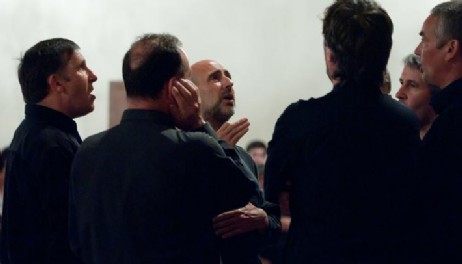
Foto: Ensemble Organum

   Cuando, allá por 1982, Marcel Pérès regresa de su periplo estudiantil, por países como Gran Bretaña y Canadá, funda el Ensemble Organum en la Abbaye Notre-Dame de Sénanque, con el que pretendía poder dar salida interpretativa a sus investigaciones en el campo de la música vocal medieval. Ya han pasado 31 de aquello, y el Ensemble Organum es considerado hoy día como uno de los máximos exponentes de este tipo de repertorios en el panorama mundial. Además, la sapiencia de Pérès en este campo no es puesta en duda por nadie. Sin embargo, una de las características que ya adornaban cualquier apuesta del conjunto desde sus inicios sigue sin cambiar un ápice: la controversia está siempre servida.

   Los principales postulados interpretativos que Pérès pone al frente de sus versiones se basan en una concepción clara y firme que este defiende con uñas y dientes: los cantos medievales de Europa estaban fuertemente influidos por toda una serie de liturgias que marcaron de manera decisiva al canto gregoriano y la posterior e incipiente polifonía, los cuales provienen de multitud de cantos de diversas regiones, muchos de corte africano y del Oriente próximo, por lo que se ven rebosantes de melismas de corte mucho menos conservador y puro de lo que Solemes comenzó a promulgar hace ya varias décadas. Así, todas estas piezas monódicas, pero también las polifónicas, se convierten en una amalgama de sonidos que a uno le pueden hacer trasladarse a lugares mucho más lejanos de lo que Limoges, Moissac, Notre-Dame de Paris o Compostela le pueden sugerir -no así quizá Toledo, por razones obvias.

   De esta manera se presentaba así el conjunto francés en la hermosa catedral leonesa, para cerrar el breve ciclo que el Centro Nacional de Difusión Musical ha coproducido con el Festival Internacional de órgano Catedral de León y que bajo el título de Peregrinatio, llevó a este lugar conciertos de Alia Mvsica, Eloqventia y este que hoy comentamos aquí. Conformado por cinco miembros -la crisis se sigue notando en la sensible rebaja en el número de miembros de los conjuntos a la hora de viajar-, nos trasladaron literalmente a pleno siglo XII -algo que, salvando una pequeña brecha temporal, es, por otra parte, bastante fácil en esa localización extraordinaria-, haciendo un recorrido por algunos de los grandes códices y piezas de la música vocal del siglo XII europeo. Desde las piezas que Perotin y Leonin compusieron para la célebre École de Notre-Dame, hasta otras contenidas en el Codex Calixtinus, pasando por algunas de orígenes variados: Moissac, Toledo y Limoges. Usando la catedral como un medio acústico formidable, los cinco cantores procesionaron de manera incesante por las naves catedralicias, teniendo el coro como «base de operaciones» -todo un privilegio poder escuchar el concierto desde ese lugar, no solo por lo acústico, sino por el valor histórico-artístico del mismo [agradezco enormemente a la organización del FIOCLE dicho privilegio].

   Pues bien, para cualquier que conozca mínimamente lo que es el Ensemble Organum, el concierto del pasado sábado pudo sorprenderle en la medida en que algunas de la tesis desarrolladas por Pérès y los suyos pueden seguir resultando, cuando menos, arriesgadas. Y es que esos bordones, el juego con las diferentes estrofas y, sobremanera, el uso de los melismas de claro corte orientalizante, puede seguir sacando de sus cabales a más de uno -el debate acerca del uso de estos melismas para repertorios septentrionales, o la adecuación de los melismas para unos repertorios en detrimento de otros, sigue estando más que vigente. No es que el conjunto francés haya ido nunca en busca de una técnica pulcra, sino que el efecto sonoro está por encima de la brillantez técnica. En eso no han cambiado, pero los años no pasan en balde, y la avanzada edad de sus miembros, sumada al escaso número de componentes, hicieron que en muchos momentos el timbre no resultase todo lo depurado que pudiera, o que la afinación adoleciese de severos desajustes en muchos momentos. Además, la tendencia de Pérès a terminar algunas palabras y frases unos pequeños instantes antes que el resto de los cantores resultaba -escuchada de cerca- algo molesta.

   Sin embargo, fueron otras las cualidades que el conjunto desprendió durante su actuación: la pasión por lo interpretado, el interpretar directamente de copias de originales, el profundo conocimiento de los repertorios, su capacidad evocadora y su variedad interpretativa, entre otras muchas, consiguieron crear un ambiente de esos que es difícil lograr para otro muchos artistas. Fantástico el juego de solistas con todo el conjunto, así como la solvencia de estos cantores en las obras en la que se exigía el concurso de un solo cantor por parte -destacando especialmente entre todos el cantor con la tesitura más aguda del conjunto, que se mostró impecable en todas sus intervenciones. El aspecto «escénico» es siempre un factor a destacar entre las cualidades de los franceses, puesto que con sus túnicas, velas y deambular consiguen trasladar a los oyentes a un período tan lejano en lo temporal, pero también en lo intelectual como es el Medievo.

   La música, de gran belleza, tuvo algunos de sus picos en el Vellvs rore u Ora pro nobis Sancta Maria, de Sain Martial de Limoges, en el Benedicamvs Domine, de Leonin o en el celebérrimo Congaudeant Catholici, del Codex Calixtinus -cualquier parecido con el resto de numerosas versiones que hayan podido escuchar es casi pura coincidencia. Una música que, aún con todo, brilló con luz propia en las personales y siempre controvertidas versiones del Ensemble Organum.

   Punto y aparte merece el público leonés. Uno se cansa ya de plantearse si la cultura y la música son realmente tan «para todos» como algunos promulgan. Personalmente, después de muchos años acudiendo a conciertos como este, cada vez debo reafirmarme más en la idea de que no. Y es que un programa de estas características a veces ni siquiera es fácilmente asumible por un público experto, y a fe que el leonés no es tal, por lo que el «peregrinaje» del título se trasladó también a muchas de las personas que comenzaron a abandonar sus asientos tras las primera piezas -el goteo fue constante. Además, la falta de sensibilidad y raciocinio llevó al propio Pérès a tener que gritar silencio en dos momentos de la actuación, ante los inoportunos aplausos que el «respetable» emitía. Incluso entre algunos de los VIPs hubo que sufrir constantes cuchicheos, ruidos y actitudes fuera de lugar. Lástima, porque, aunque el FIOCLE consigue hacer rebosar de gente las naves de la catedral leonesa, no lo hace quizá con el público deseable. Puede que cuando el cabildo deje que este tipo de actuaciones puedan realizarse cobrando una mínima entrada, dicho problema deje de suponer un auténtico incordio y un agravante para los oyentes especializados y conscientes que también son.

   En definitiva, un concierto que sorprendió sobremanera a aquellos neófitos en lo que al Ensemble Organum se refiere, y que no dejó indiferente a los muchos que ya sabían de sus andanzas, pues si bien la excelencia sigue siendo marca de la casa para Pérès y sus cantores, el paso de los años van haciendo mella y la calidad del conjunto se ha resentido en los aspectos más técnicos de sus lecturas.

sábado, 12 de octubre de 2013

The Choir Project al día [12-X-2013]

Sacred Music [I]: I. The Gothic Revolutions.
The Sixteen - Harry Christophers.
A choral history on video
.

BBC is, probably, the best national broadcasting company in the world. British are able to put all their technical quality and talent at the service of culture and music.
This is one of the most fantastic examples of this. "Sacred Music BBC Series" is a wonderful journey through the history of choral music from the Middle Ages to our days.
The Sixteen put to the service of this company his musical knowledge and high choral quality.
In the next few weeks we'll bringing here a new chapter in this essential series.

Enjoy choral music!


sábado, 4 de mayo de 2013

The Choir Project al día [04-V-2013]

Anonymous: Purgator criminum à 3.
Gothic Voices - Christopher Page.
English and French medieval Polyphony.


   Christopher Page wrote about this album:
"'And on that day, as I have been assured, the King of England, a lance in his hand, rode down the whole length of our army, and none of our men did come forth to challenge him.
Bohadin'.

   This is how Richard the Lion Heart taunted the Saracens at Jaffa in the month of August, 1192. Our witness is Bohadin, an Islamic chronicler who had every reason to speak ill of Richard or to pass silently over his many acts of bravery. Nonetheless, Bohadin can do neither of these things. Eight centuries later, his words reveal that the legend of Richard the Lion Heart rests upon a firm basis of truth. Arrogant, selfish and cold he may have been, but there is no doubt that Richard was one of the most courageous and indefatigable kings that England has ever known.

   Early in the month of November, 1187, Richard heard the news that was to change his life. He was at Tours when he learned how the forces of Islam had achieved a great victory at the Horns of Hattin some fourteen miles north-east of Nazareth. The details were terrible to hear, for the relic of the Holy Cross had been snatched from Christian hands. Furthermore, the gains of the First Crusade now lay in ruins; the Latin King of Jerusalem, Guy of Lusignan, had been captured by a sultan whose very name was a challenge to a French tongue: Salahadinus—the indomitable Saladin. The news had come in the evening; by the next morning Richard had ‘taken the cross’ from Archbishop Bartholomew and vowed to embark on what was to become the Third Crusade. A year and a half passed by as the host was made ready, and then, on 6 July 1189, Richard’s tempestuous father, Henry II, died at Chinon. Richard crossed the channel to England, paused at Winchester, and then proceeded to London where, on 3 September, he was crowned as Richard I in Westminster Abbey. Before he set foot in the land ‘where the King of Glory had trod’, Richard became a king himself.

   During Richard’s lifetime the principal forms of secular court music were the conductus and the chanson. A conductus was an accentual Latin poem set to music for one, two, three or even four voices. The number of parts in a conductus governs not only its sound but also its style in performance, for the addition of voices usually increases the drive and aggressiveness of the work. When there is only one voice, as in Anglia, planctus itera, the singer is free to give the piece a spacious, even a rhapsodic character, especially when the setting is a melismatic one as is the case here. The style of Anglia, planctus itera, a lament for the death of Richard’s brother Geoffrey, Count of Brittany (d1186), shows that melismas (where many notes are provided for one syllable) were felt to raise the tone of a monophonic composition, helping to produce a High Style appropriate to an elegy with a royal subject. In this instance the composer increases the prominence of the melismas by allowing some words to pass in succession with only one note per syllable. A striking example is provided by Mors in te sevit aspere in the first verse.

   When there are two parts in a conductus, however, which must of course be synchronized, the music enters the realm of musica mensurabilis and therefore works in a different way. A strict rhythmic discipline and stylistic restraint are necessary to project the highly regulated and often somewhat austere nature of pieces such as Sol sub nube latuit, In occasu sideris and Pange melos lacrimosum. A performance of these works requires not only the scrupulous measurement of time described by medieval music theorists (mensura), but also the prudent and noble restraint celebrated by contemporary poets in French (mesure). A quality of high seriousness is essential to at least the two-part conducti of English origin like those mentioned above, and it would be misleading to describe these pieces (or any other pieces on this record) as ‘declamatory’ if that word implies a dramatic and demonstrative response to the meaning of the text. For twelfth-century musicians the relationship between words and music was an essentially temperate one, and the finished work had a lapidary quality, cool to the touch.

   With a three-part conductus like Novus miles sequitur the situation changes once again. Since the three parts share many of their melodic and rhythmic figures the texture has a repetitive quality, even an exhilarating monotony, demanding a tempo that seems almost pressed in its determination to move the piece forward. The three-voice conducti Hac in anni ianua and Purgator criminum also show how a three-part texture creates a powerful forward movement. In a four-part work like Mundus vergens, the friction between the parts becomes intense.

   Throughout the period covered by this record (c1170– c1200), the conductus was the principal form of ceremonial music. The texts of conducti were invariably in Latin, and the form therefore possessed a distinctly learned ethos. It was one that contemporaries associated with the High-Style poetic imagery of lamentation (falling stars, the sun in eclipse) and of celebration (the Golden Age, the springtime of peace, and so on).

   In the last decades of the twelfth century a subtle art of love song developed in north-east France. It is now customary to refer to the composers of these songs as the trouvères, although the term trouvère meant a poet of any kind in the twelfth and thirteenth centuries. The summit of the trouvères’ art, the chanson, was a love song in as many as five stanzas, whose text was usually a reflection upon the fortunes of loving. Among the distinguished trouvères of Richard’s day were Gace Brulé‚ (who had associations with Richard’s brother Geoffrey, Count of Brittany), Chastelain de Couci, and the trouvère whose name had already entered the Richard legend by the thirteenth century, Blondel.

  The chanson and the conductus were related in various ways. Indeed they sometimes shared the same material. The melody of Blondel’s chanson L’amours dont sui espris forms the lowest voice of the conductus Purgator criminum, and the music of Blondel’s Ma joie me semont forms one of the parts of the "conductus" "Ver pacis apperit". The challenge facing the composer of a polyphonic conductus was to devise two, three or even four melodies which possessed the shapeliness of free-standing songs but which produced an exhilarating result when sung simultaneously. The overlap between the chanson repertoire and the conductus indicates the importance of the melodic element in the contemporary judgement of conductus style. As if to emphasize the melodic aspect of their art, the composers of two-part conducti often begin their settings with the musical form A–B–A–B which is found in the first four lines of so many trouvère songs (including all the examples recorded here). It was part of the contrapuntal art of the conductus, however, to use this A–B–A–B pattern in just one of the parts; the second part, freely composed, was then able to vary the counterpoint. In Sol sub nube latuit, for example, the music of the first four poetic lines, as they are sung by one voice, has the form A–B–A–B, but the other voice is free, relating to the first A–B of its fellow in a suave and consonant way but deliberately establishing a series of stressed fourths and dissonances over the second B. In the first verse of the poem this can be heard on the words Summi patris filius.

   The chansons recorded here reveal something of the subtlety of the trouvères’ art of melody. The songs by Blondel, especially L’amours dont sui espris, have a light and airy quality arising from Blondel’s decision to use poetic lines of only six syllables each. Since one musical phrase in a trouvère song (as in a conductus) is almost always equivalent to one complete poetic line, Blondel’s poetic brevity gives his melodies a delightful clarity. (In some pieces, however, the equation between the poetic line and the musical phrase is subverted, and to exhilarating effect; this happens in the third verse of Etas auri reditur, where the complex enjambement of the poetry shapes the musical phrases in an unusual way.) In contrast to Blondel’s two songs, Gace Brulé’s A la douçour de la bele seson, represents the grand manner of the trouvères. This time the lines form grandiloquent decasyllables and the melody is much larger than in Blondel’s songs; in performance, it takes longer for the listener to bring the melody into focus and to locate its points of tension and release. This process of discovery is an important part of the aesthetic experience that a trouvère song provides.

   These chansons and conducti would have been sung in a variety of courtly contexts. The term ‘courtly’ can be interpreted widely, for it embraces any place where the superior members of a household, be it lay or ecclesiastical, were gathered together. The entourage of a bishop with its staff of notaries and other clergy, swelled by clerical visitors going about the business of the diocese, and perhaps a few lay persons of consequence, seems a likely audience for much of this music, and in this case the ‘court’ could be anything from an official episcopal residence to a small town house or hostelry commandeered by the bishop’s household on its travels.

   Like Vetus abit littera, this conductus for Christmas season dsiplays the deep disdain for the Jews and the Jewish religion which was a constant and destructive force in the civilisations of Western Christendom throughout the twelfth adn thirteenth centuries. The coronation of Richard I on Septiember 3 1189 produced a torretn of anti-semitic feeling in England with terrifying results. On that day, on an subsequent days, the Jews of England formed a "ludea misera" indeed."

   This album is really great, with on of the best medival piece composed in Great Britain.
Gothic Voices and Chris Page are probably the leading experts in this repertoire, as demonstrated in his extensive discography for Hyperion Records.
Fantastic performance and singers for a fantastic pieces, with large compositional quality and rarely performed. Well done!